💡 The First Thing to Understand
You don't need to "develop" intuition. You need to stop blocking it.
Your intuition is already functioning. It speaks to you constantly. The problem is that you've been trained since childhood to ignore it, override it, and trust "logic" instead.
Intuition development isn't about gaining a new ability. It's about removing the interference between your intuitive knowing and your conscious awareness.
What Intuition Actually Is
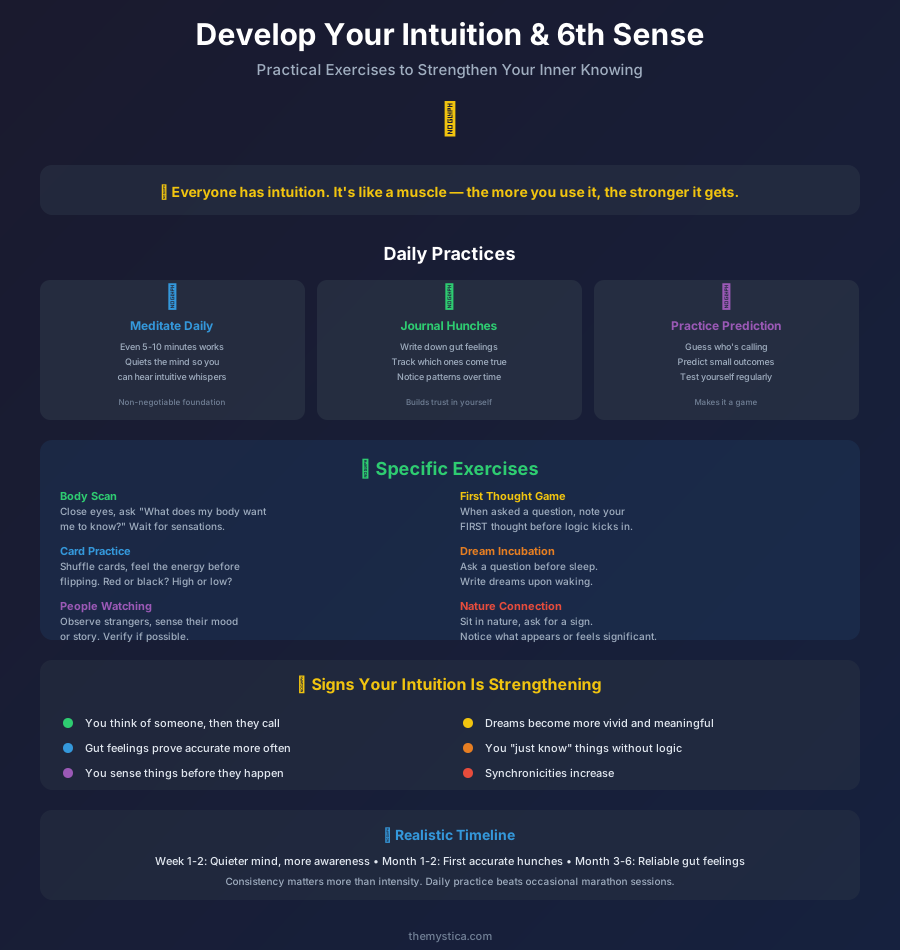
Intuition is your brain's ability to process vast amounts of information below conscious awareness and deliver conclusions as feelings, hunches, or instant knowing.
It's not magical. It's pattern recognition operating faster than your analytical mind. Your unconscious processes millions of data points—micro-expressions, tone shifts, environmental cues, past experiences—and hands you a summary: "Something's off here" or "Trust this person" or "Take that opportunity." Research published by the American Psychological Association has found that decisions made this way are held with more certainty and more consistently reflect what people actually value — not just guesswork.
This isn't to say intuition is purely biological—many people experience intuitive knowing that extends beyond explainable perception. But understanding the baseline helps you work with it better.
Why You're Probably Blocking Your Intuition
Most people don't have weak intuition. They have strong interference. Here are the most common blocks:
Block #1: The Override Habit
Your gut said "don't trust that person" but your logic said "don't be paranoid" so you overrode the feeling. When your gut proved right, you didn't learn to trust it—you learned that your gut "wasn't loud enough to listen to." Every override trains your system to speak more quietly.
Block #2: Noise Pollution
Constant input—news, social media, other people's opinions—drowns out the subtle signal of intuition. If your mind never gets quiet, you can't hear the whisper underneath the noise.
Block #3: Confusing Intuition with Fear
Anxiety feels urgent and important. So does intuition. Many people can't tell the difference, so they either ignore both ("I'm probably just anxious") or obey both ("Every bad feeling must mean something"). Neither serves you.
Block #4: Wanting to Be Right
Intuition speaks in maybes. Ego wants certainty. If you're only willing to trust information that comes with guarantees, you'll miss most of what your intuition offers.
Intuition vs. Anxiety vs. Wishful Thinking
This is the most important skill in intuition development. Here's how to distinguish them:
| Intuition | Anxiety | Wishful Thinking |
|---|---|---|
| Arrives suddenly, without buildup | Builds gradually, often spirals | Present when thinking about what you want |
| Feels calm or neutral underneath | Feels urgent, panicky, restless | Feels excited, hopeful, attached |
| Simple, often single message | Complex, creates scenarios and what-ifs | Conveniently supports your preference |
| Doesn't argue with you | Engages in mental debate | Looks for confirming evidence |
| May contradict what you want to hear | Usually confirms worst fears | Always confirms best hopes |
| Fades naturally after delivery | Persists, demands attention | Returns whenever desire returns |
🎯 The Key Test
Ask yourself: "What do I WANT the answer to be?"
If your "intuition" conveniently matches what you want—be suspicious. Genuine intuition often surprises you or tells you things you don't want to hear.
If your "intuition" conveniently matches your worst fear—that's probably anxiety disguised.
Real intuition tends to be neutral, matter-of-fact, and uninterested in your emotional reaction to it.
The 3-Week Intuition Reset
This isn't about becoming psychic. It's about recalibrating your relationship with your existing intuitive sense.
Week 1: Reduce Interference
- Morning silence: 10 minutes before consuming any information (no phone, no news, no conversation)
- Input reduction: Cut social media by 50% this week
- Body check-ins: 3x daily, pause and notice what your body feels (not what you're thinking—what you're physically sensing)
Goal: Create space for subtle signals to be noticeable.
Week 2: Start Tracking
- Intuition journal: Every time you get a hunch, gut feeling, or unexplained knowing—write it down BEFORE you know the outcome
- Include: Date, the intuitive hit, how it arrived (image, feeling, knowing, words), your emotional state at the time
- Note outcomes: Later, record whether the intuition was accurate
Goal: Build data about your intuitive patterns.
Week 3: Active Testing
- Low-stakes predictions: Before checking email, guess who wrote. Before answering phone, guess caller. Before entering room, sense the energy.
- Record everything: Don't only count "hits"—track misses too
- Notice patterns: Are you better with people? Situations? Timing? Certain topics?
Goal: Understand how YOUR intuition works specifically.
🧘 The Daily Intuition Practice (5 minutes)
- Settle (1 min): Close eyes, take three deep breaths, feel your body
- Ask (30 sec): "What do I need to know today?" or "What should I pay attention to?"
- Receive (2 min): Notice what arises—images, feelings, words, body sensations. Don't analyze. Just observe.
- Record (1 min): Write down impressions without judgment
- Release (30 sec): Let go of attachment to being "right." Continue your day.
End of day: Review briefly. Did anything connect to what happened?
The Feedback Loop Problem
Here's why most intuition development fails: no feedback loop.
You have a hunch. You act on it (or don't). Something happens. But you never systematically connect the hunch to the outcome. So your system never learns which signals to amplify.
The solution: Track predictions and outcomes. Over time, you'll notice:
- Which types of hunches are reliable
- Which situations you read well
- What "accurate intuition" feels like versus "inaccurate intuition"
This feedback teaches your system what to pay attention to. Without it, you're guessing in the dark.
When NOT to Trust Your Intuition
⚠️ Intuition Is Unreliable When:
- You're emotionally invested in the outcome
- You're exhausted, hungry, or sick
- You have strong desires or fears about the situation
- You're under time pressure to decide
- The topic is completely outside your experience
- You're asking repeatedly about the same thing (seeking the answer you want)
In these conditions, use logic, gather information, and don't mistake emotional noise for intuitive signal.
The Long Game
Intuition strengthens over years, not weeks. The people with reliable intuition have typically:
- Spent years paying attention to subtle signals
- Built massive experiential databases their unconscious draws from
- Learned their personal patterns of accurate vs. inaccurate hunches
- Developed comfort with uncertainty and being wrong
You're not going to transform your intuition in a month. But you can start the process. Every time you notice a hunch, record it, and check the outcome, you're teaching your system that intuitive information matters. Over time, it speaks louder.
Final Thoughts
Your intuition is already working. The question is whether you're listening, whether you can hear it through the noise, and whether you can distinguish it from anxiety and wishful thinking.
Start simple: reduce noise, track hunches, review outcomes. That's enough for the first month. Everything else builds on that foundation.
And remember: intuition is a supplement to good judgment, not a replacement. The goal isn't to make every decision based on gut feeling. It's to have another source of information—one that catches what your analytical mind misses.